
ESUNT (End-To-End Secure User Network Technology) is designed to protect digital communications through an independent over-encryption process. Under the proposed workflow, participating devices would establish a shared secure context, apply cryptographic protection locally, and exchange protected content through an existing communication platform or a dedicated ESUNT application.
How the Protection Process Works
ESUNT separates the protection of communication content from its transmission. The proposed workflow consists of four stages: establishing a secure relationship, preparing local cryptographic material, protecting outgoing content, and recovering it at the receiving endpoint.
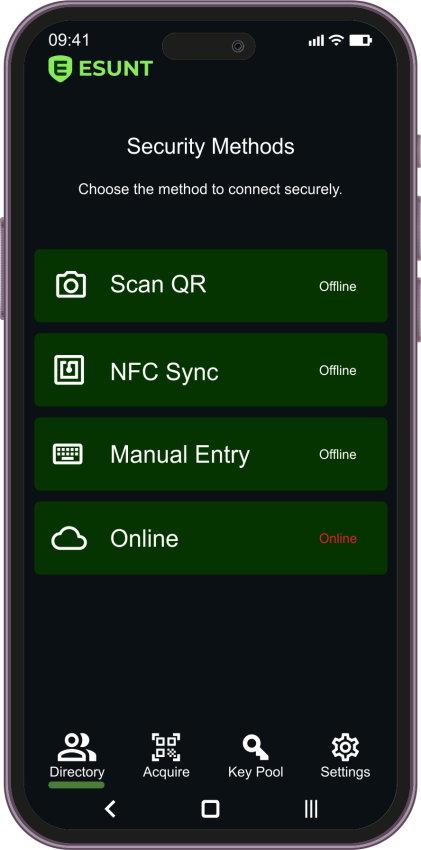
1. Establishing a Secure Relationship
Before protected communication begins, participating users establish a shared secure context between their devices.
ESUNT is designed to support user-controlled establishment methods, including in-person exchanges using QR codes or NFC, as well as alternative methods for participants who cannot meet physically.
These methods provide the information needed for participating devices to establish a corresponding cryptographic context.
2. Preparing Local Cryptographic Protection
Once the shared context is established, participating devices are designed to generate corresponding cryptographic material locally.
ESUNT's elliptic-curve-based architecture allows the additional protection layer to operate without delegating cryptographic key management to the underlying communication provider.
Key derivation, synchronization, and management are integral parts of the proposed ESUNT architecture.
3. Protecting Outgoing Communications
Before outgoing content enters the underlying communication application, ESUNT is designed to apply an additional encryption layer locally.
For example, when used alongside a compatible messaging application, ESUNT protects the content before passing it to that application. The communication platform then handles transmission through its normal infrastructure, including any encryption mechanisms it already provides.
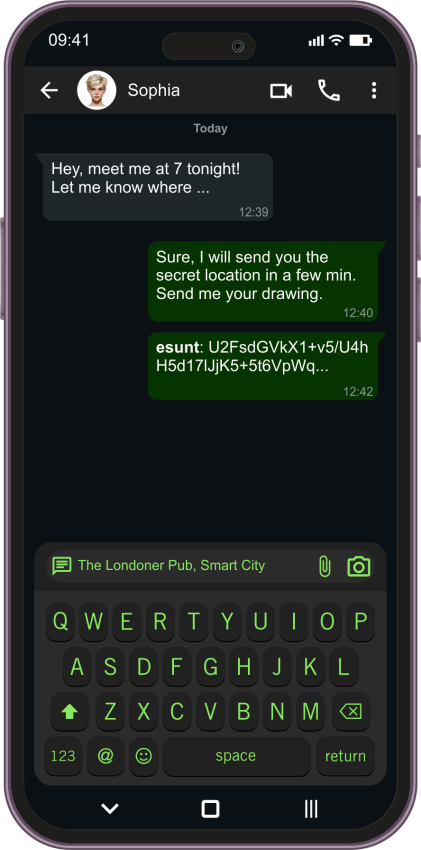
4. Recovering Content at the Receiving Endpoint
The receiving application delivers the additionally encrypted content through its normal communication process.
At the receiving endpoint, ESUNT would use the corresponding locally available cryptographic material to recover the original content within its controlled environment.
The communication provider does not need access to the ESUNT cryptographic context to transport the protected information.
Communication Through Existing Platforms
One of ESUNT's principal objectives is to reinforce existing communication services without requiring users to abandon them.
The underlying platform continues handling connectivity, message delivery, and other established functions, while ESUNT provides independent protection for the content.
Practical compatibility and integration depend on the capabilities and technical limitations of each communication platform.
Secure Contacts and Groups
ESUNT's proposed design supports multiple secure communication relationships, allowing users to organize individual contacts and groups within their protected communication environment.
Each relationship can have a separately managed cryptographic context, allowing independent control over the protection associated with different contacts and groups.
Local Control and Key Management
Local cryptographic control is a central principle of ESUNT. The architecture is designed to support the generation, management, rotation, and removal of cryptographic material on participating devices.
These capabilities are intended to give users direct control over their additional encryption layer, independently of the underlying communication provider.
From Architecture to Implementation
The workflow described here represents ESUNT's intended operation. Its implementation, usability, interoperability, and security properties will be evaluated during development of the minimum viable product (MVP).
The initial MVP will focus on demonstrating secure-context establishment, local cryptographic operations, and the end-to-end protected communication workflow before extending the implementation to additional features and platforms.