
ESUNT's proposed security architecture separates the protection of communication content from the platform used to carry it. The goal is to give participating devices independent control over an additional encryption layer, without requiring the communication provider to manage the ESUNT cryptographic context.
Independent Security by Design
End-to-end encryption provided by communication platforms can be strong, but its effectiveness depends on the provider's cryptographic implementation, software updates, and operational practices.
ESUNT takes a complementary approach. It is designed to protect outgoing content locally before that content enters the underlying communication platform.
When the platform also provides encryption, the two independently managed layers can operate together, reducing reliance on a single cryptographic implementation.
Elliptic-Curve Cryptographic Foundation
ESUNT's architecture uses elliptic-curve cryptography as a foundation for establishing secure relationships and generating locally controlled cryptographic material.
Elliptic-curve techniques support efficient cryptographic operations on devices with different computational capabilities, including smartphones and desktop computers.
However, elliptic-curve cryptography alone does not guarantee communication security. The resulting protection also depends on the encryption mechanisms applied to content, key management, protocol design, and correct implementation.
Locally Controlled Cryptographic Operations
Participating devices are intended to generate and manage the cryptographic material required for ESUNT's independent protection layer.
Outgoing content would be encrypted locally before being passed to the underlying communication platform. Corresponding decryption would take place locally at the receiving endpoint, using the appropriate cryptographic context.
The communication provider can transport the additionally protected content without needing access to the ESUNT cryptographic material.
Serverless Security Model
ESUNT's serverless model concerns its independent security layer. The architecture is designed to perform its cryptographic operations locally, without requiring a central ESUNT server to manage the additional encryption.
This does not mean that the underlying communication service must operate without servers. Existing messaging, telephony, and data-exchange platforms may continue using their established network infrastructure.
Secure Relationships and Cryptographic Separation
ESUNT is designed to support multiple secure communication relationships, including individual contacts and groups.
Each relationship can be associated with a separately managed cryptographic context. This separation is intended to limit the consequences of a compromise affecting one relationship, rather than automatically exposing unrelated communications.
The effectiveness of this separation depends on how cryptographic material is generated, stored, synchronized, and managed.
Key Management and Rotation
The proposed architecture includes local key management, key rotation, and the removal of selected secure communication contexts.
These mechanisms are intended to allow users to maintain, update, or discontinue secure relationships independently of the underlying communication provider.
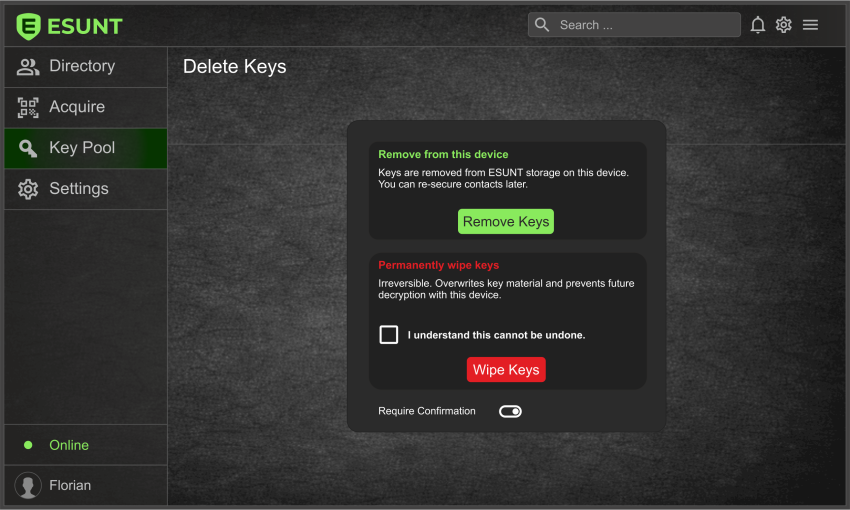
Removing cryptographic material may prevent further access to content protected by those keys. However, secure deletion depends on correct implementation, device storage behavior, and backup handling. It does not necessarily erase plaintext or copies of communication content stored elsewhere.
Security Boundaries and Limitations
An independent encryption layer can reduce reliance on the underlying communication provider for content confidentiality, but it cannot eliminate every security risk.
Compromised devices, malicious software, insecure user behavior, traffic analysis, and disclosure of information outside the protected communication path remain potential threats.
The effectiveness of ESUNT also depends on device integrity, the trustworthy establishment of secure relationships, and the correct management of cryptographic material.
ESUNT is therefore intended to reinforce communication security, not to guarantee anonymity, complete privacy, or protection against every possible attack.
Implementation and Security Validation
ESUNT's security architecture currently describes the intended design of the technology. Its practical security properties must be established through implementation, testing, and independent technical assessment.
The planned minimum viable product (MVP) will provide an initial basis for evaluating secure relationship establishment, local cryptographic operations, and protected communication between participating endpoints.
Further evaluation will address implementation correctness, interoperability, key-management security, and resistance to relevant attack scenarios.
Until these activities have been completed, the architecture's security capabilities should be understood as development objectives rather than independently verified guarantees.